A career in potatoes (Guest Blog)

Dr Kerry Leslie, Potato Consultant at SAC Consulting (Part of SRUC)
Reflecting on my journey from research into practical application on the ‘International Day of the Potato’ (30 May), I have been reminded of my long-term fascination with the humble tattie.
I’ve always loved potatoes and, though it might sound strange, I knew in High School that I would end up working with them in some capacity. Not only do they taste good, but they are a hugely important crop for Scotland and most importantly (for me), they are hosts for many fascinating pests and diseases which I have gotten to know in depth throughout my studies and into my career.
Life at St Andrews
I started my academic career with my undergraduate degree in microbiology at the University of Dundee, before narrowing my focus on potato pests for my PhD.
I began my PhD at St Andrews in 2016, though I was based at the James Hutton Institute in Dundee due to the availability of facilities for plant sciences (e.g., glasshouses) on the St Andrews campus at the time. In this way, my experience of the research culture at the university was possibly at arm’s length compared to students based on campus, though it did not impact on my research or my experience of St Andrews as a whole.
One of my biggest learnings from this time was ‘It really does take a village to raise a PhD’ (or something like that). Getting to know your fellow PhD students and supporting one another through the tough days – where yet another experiment fails and it feels like its make or break – forges lifelong friendships with people you can count on. I am certain that will hold true for today’s students as much as it did for me.
A brief history of my PhD thesis
My PhD thesis was “Core effectors of plant-parasitic nematodes and their host targets”, supervised by Dr Sophie Mantelin, Dr Sebastian Eves-van den Akker and Professor John Jones.
Nematodes are microscopic worms that live ubiquitously across the globe, adapting to most environments from Antarctica[1] to hydrothermal vents. Many nematode species are parasites of plants and live in our agricultural soils. It is estimated that nematodes contribute to $80 billion (USD) annually in lost crop yields[2]. However this statistic is from 2011… so it is likely much higher now.
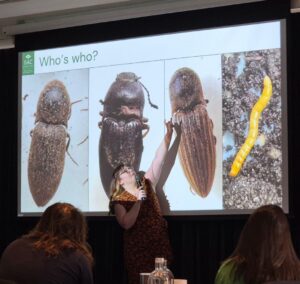
The PhD research focused mainly on how potato cyst nematodes (PCN) invade potato plant roots, manipulate them from the inside, and survive long enough to feed and reproduce on a molecular level. They create specialised feeding sites called syncytia by reprogramming plant cells into reservoirs of nutrients. To do this, the nematodes release effector proteins, for example enzymes which interfere with the plant’s normal biology and try to circumvent the host immune system. In general, understanding what effectors the nematodes produce is important because if we can block their function, we may be able to stop successful parasitism and ultimately find ways to protect the potato plant from damage.
Rather than studying every effector these nematodes can produce, my research focused on identifying a group of ‘core effectors’. These are proteins shared by several damaging nematode species but absent (or significantly different structurally) from non‑parasitic species, suggesting they play a key role in parasitism. This was carried out using the genomes and transcriptomes of plant parasitic nematode species Globodera rostochiensis, Globodera pallida, Rotylenchulus reniformis, and Nacobbus aberrans.
What did the research find?
- I confirmed a set of candidate core effector proteins (GROS_g02394, GROS_g02469, and GROS_g05682) from the nematodes secretory glands and identified interacting proteins from the potato plant, allowing us to infer their function.
- I identified GH53 endo-β-1, 4-galactanase enzymes that help the nematodes move through root tissues by breaking down pectin sidechains in the plant cell wall.
- I also worked on a conserved family of Cathepsin L-like peptidases found in the nematode intestines.
Why does it matter?
My research contributed to identifying potential targets for future crop protection strategies. Rather than overreliance on broad‑spectrum pesticides, this kind of knowledge supports the future development of more sustainable (potentially genetic) control methods for example, breeding new potato varieties that can resist infection by blocking nematode effectors from functioning. Not only this, plant parasitic nematodes such as PCN have an enormous impact on food security. By uncovering how they operate at a molecular level, this research helps us step toward healthier more resilient crops with better yields in the future.
The above paragraph is a very blue-sky way to approach research. My project was exploratory, which is needed for advancements in science. However, if I were asked about how potato growers could use this information to help with their current crops back then, I would have struggled to give an immediately practical answer. Which is where my post -PHD experiences make all the difference.
Research beyond traditional academia
When I finished my PhD, I quickly realised that my time in traditional academia was ending. While still a lover of research, I wanted to be at the coal face of practical application, which is often not an avenue afforded to researchers as they battle with the funding cycles to keep at the forefront of learning.
After a few lecturing positions and working for SASA (the agricultural division of Scottish Government), I took up my current role as a potato consultant with SAC Consulting, which is part of Scotland’s Rural College (SRUC).
Despite missing my lab bench and molecular research sometimes, I think I have found a role that gives me a career for life. Everyday is different at SAC Consulting, but the ultimate focus of my job is to deliver practical help, guidance, and advice to members of the UK potato growing industry.

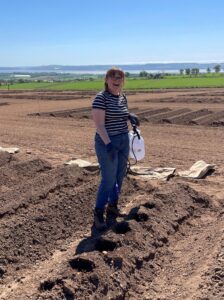
This ranges from giving individual support to those with specific issues (e.g., pest and diseases in crops, and running small regional agronomy groups with growers) to hosting our annual conference and open days. My team also runs one of the largest potato field trials programs in Scotland, so I am no stranger to getting my boots muddy in active field research – literally.
To swing back round to PCN – for the last three years I have been the knowledge exchange lead for the PCN Action Scotland project (www.pcnhub.ac.uk). PCN Action Scotland was a five-year Government funded project consisting of government, academic, and industry collaborators across nine work packages. These work packages included core research (both lab and field based) which informed new policy change proposals, created new tools to help growers with PCN management, and recommended incentives for improved PCN management to Scottish Government.
Historically, having PCN in your land was kept under wraps and most growers didn’t dare to discuss it openly. A mission of the PCN Action Scotland project was to change this – increasing visibility of the problem faced in Scotland, whilst providing clear information and advice to the industry on how to decrease current PCN populations present whilst safeguarding land from future infections.
Being part of this project has been a real highlight in my career – bringing me back to my roots. It has allowed me to use my PhD to positively, providing tangibly impact and improving the potato industry on the ground, which, as I said at the beginning, has been a dream of mine since High School.
[1] Jon Pickup’s work on Antarctic nematodes Strategies of cold-hardiness in three species of Antarctic dorylaimid nematodes – NERC Open Research Archive
[2] NICOL, J.M., TURNER, S.J., COYNE, D.L., NIJS, L. DEN, HOCKLAND, S. & MAAFI, Z.T. 2011. Current Nematode Threats to World Agriculture. In Genomics and Molecular Genetics of Plant-Nematode Interactions. Dordrecht: Springer Netherlands, 21–43., 10.1007/978-94-007-0434-3_2.